
Building it. Repairing it. Protecting it.
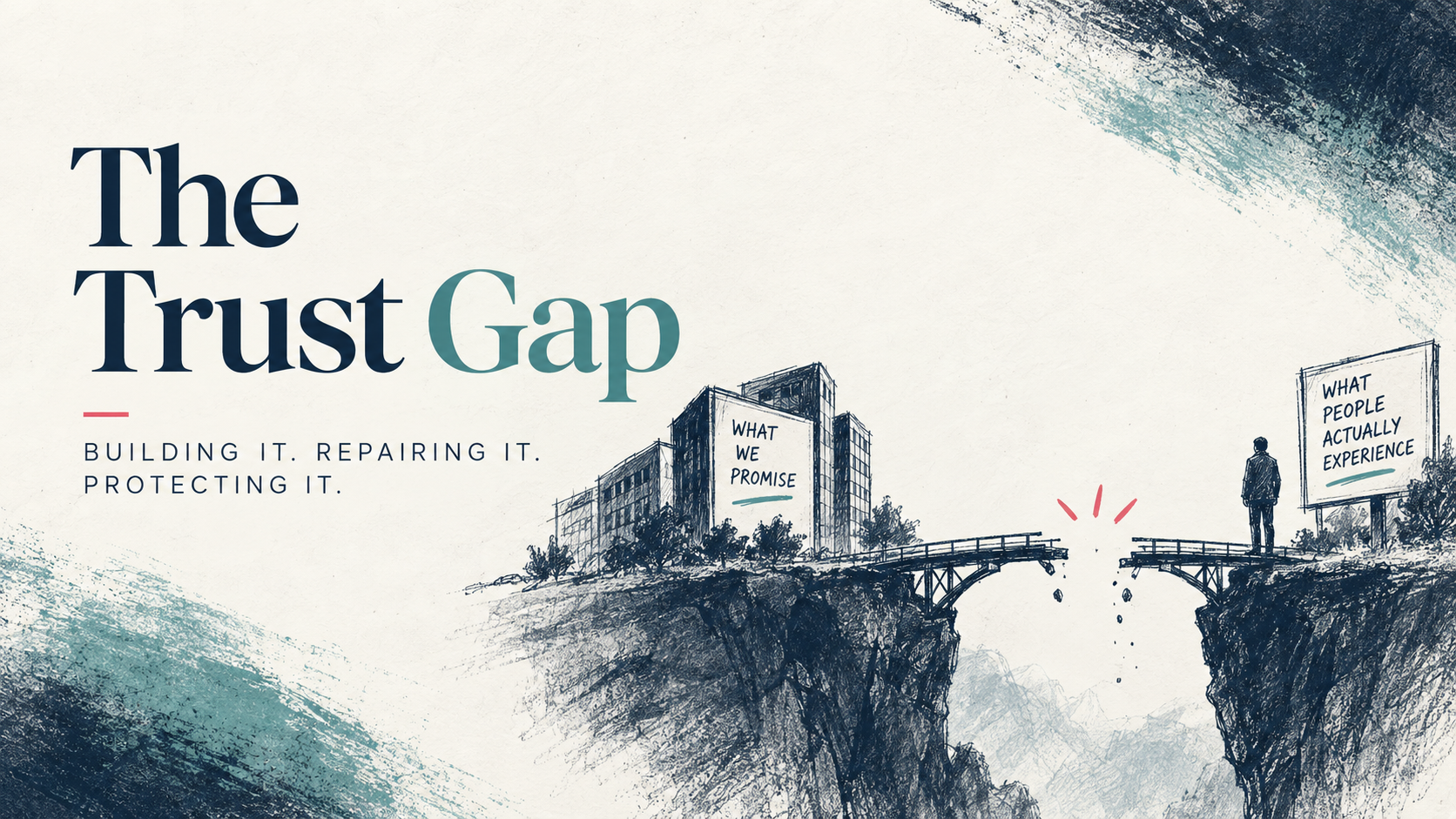
Your business might not have a trust problem. It might have a reality problem.
The strategy says one thing. The customer experience says another. Employees tell a different story. Leadership looks at the numbers and wonders why the market isn’t responding as expected.
That’s the Trust Gap: the space between what a business believes about itself, what it promises, what it does, and what customers, employees and suppliers actually experience. It’s far more than reputation. It affects whether someone chooses you, stays, recommends you, or believes you when you say you’ve changed.
PwC’s 2025 Customer Experience Survey found 52% of consumers had stopped buying from a brand over a bad experience. More revealing: 89% of executives believed customer loyalty had grown recently, versus just 39% of consumers. That gap: the business believing one thing, the customer experiencing another, is the Trust Gap in its simplest form.
Trust rarely disappears overnight. It drifts. A customer leaves. Sales get a little harder. Most organisations only notice once it starts to hurt.
We think about trust in three stages: building it, repairing it, protecting it.
1. Building Trust
Trust isn’t built by a campaign. It’s built through the accumulation of evidence. Doing what you said you’d do, a product that delivers, people who behave consistently with what the business claims to value. Businesses regularly separate these things into different functions, then wonder why the experience doesn’t feel joined up.
We’ve seen this with innovation. A business tells us it’s innovative because it has an R&D function. The first question should be: where are the customers in that process? One business we worked with started not with what it wanted to sell, but with understanding what customers actually needed. Three customers agreed to pilot it. Six years later, that business dominates its sector, because it understood a real problem and let the market experience the difference for itself.
The same logic applies to brand: how someone feels about you as a result of every interaction, not the campaign. Your customers don’t experience your organisational chart. They experience the business. That’s where trust starts.
2. Repairing Trust
Building trust is straightforward when things are going well. Repairing it is much harder. This is where businesses reach for the wrong fix. Something goes wrong, and everyone wants a new campaign or a rebrand. But a campaign can’t close a gap that operations opened. You have to behave your way out of a trust deficit, not communicate your way out of it.
One business we worked with had grown through acquisition without properly integrating what it bought. On paper, it was one organisation; in practice, it was four operating alongside each other. No single decision was obviously bad, but together they pulled the business away from what had made customers trust it. Growth hadn’t broken it. It had stretched it.
When the revenue gap appeared, the response was cost-cutting: suppliers changed, quality suffered. Eventually the business had to do the integration work it should have done originally: breaking down silos and rebuilding the proposition from fundamentals. The rebrand mattered, but it wasn’t the fix; it took 18 months to rebuild the brand and years to rebuild the trust. A new identity can tell people something has changed. It can’t prove it.
Trust isn’t one metric, either. That business had its most profitable year, while internally pay rises were held back despite the team that drove the recovery. You can repair one part of your reputation while quietly damaging another, which is why trust can’t be owned by one department.
3. Protecting Trust
Businesses tend to think about trust once they’ve lost it. The smarter question is what they’re doing now that could cost them trust later.
Protecting trust isn’t a brand style guide. It’s whether the organisation is living what it claims. Do your supplier choices match what you say you value? Are existing customers actually staying, or is growth quietly built on replacing the ones you’re losing? The useful question isn’t “would you recommend us?” It’s whether people actually do.
Early signals: sales cycles quietly lengthen, employees stop challenging decisions, your best people start leaving. These are signals, not isolated problems. Marketing can’t fix them alone, because it doesn’t own every experience that creates the brand. People judge what you value by what happens under pressure, and by whether short-term numbers are chosen over the experience that sustains them.
The Gap is Bigger When the Business is Changing
A startup has to answer why anyone should believe them. A business entering a new market has to earn a reputation it doesn’t have yet. A scaling business has to prove it can still deliver at twice the size. Different situations, same underlying problem: the business has changed, or wants to, but the belief around it hasn’t caught up.
Your Brand makes a Promise.
Your Business has to Provide the Evidence.
Trust isn’t built once and filed in a brand manual, it changes every time the business changes. You build it with evidence. You repair it by changing the behaviour that created the gap, not just the story. You protect it by continually checking whether what you say you value still shows up in what you do.
The smartest businesses don’t wait for the Trust Gap to become a crisis . They look for it while it’s still small enough to fix. You can have a brilliant strategy, a great product and a convincing story. People still won’t cross the gap if the evidence isn’t there.
Does your business keep its promise?
Get Unsmudged helps you find the gaps between what your brand promises and what your business delivers, before they become a problem.